
Applied Agentic AI Engineering for Banking Professionals
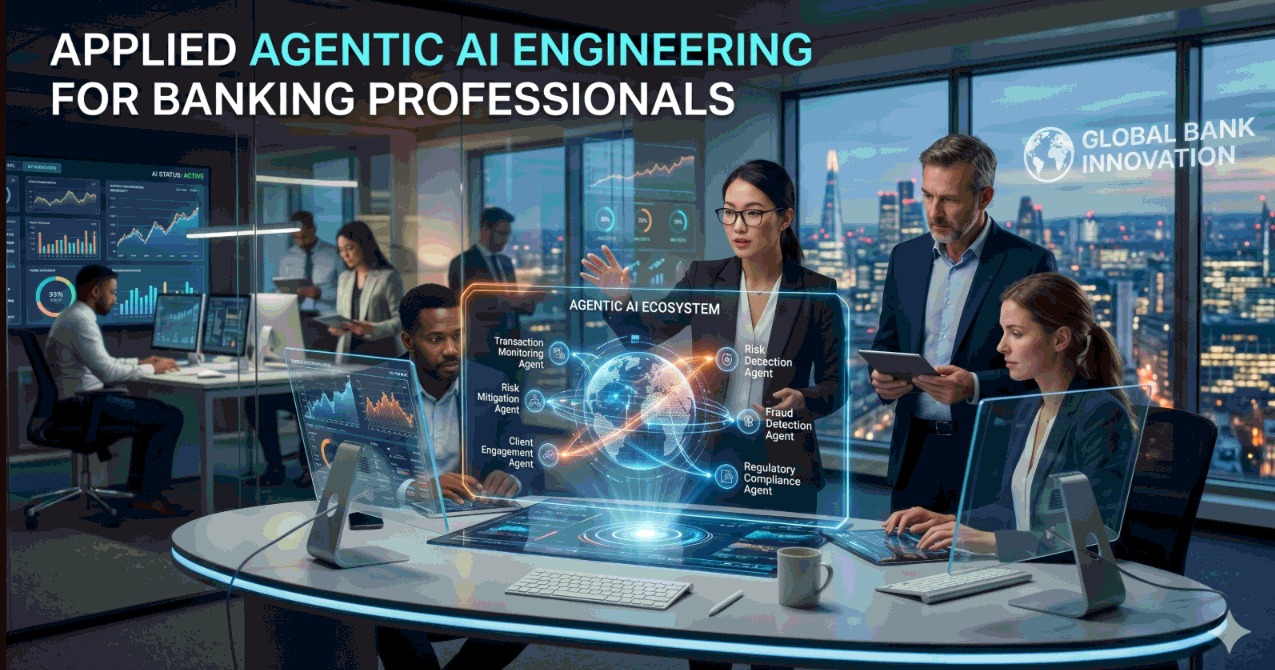
Applied Agentic AI Engineering for Banking Professionals is a 120-hour production-focused bootcamp that takes participants from Python fundamentals to building and deploying a complete AI banking assistant. Participants develop expertise in LLMs, RAG pipelines, Vector Databases, LangGraph, MCP, CrewAI, FastAPI, PostgreSQL, Streamlit, Docker, and AI governance within regulated banking environments.
Course Fee
S$2000
Course Information
Course Overview
This comprehensive 5-day programme is designed for banking professionals to learn how to build production-ready AI systems using Python, Large Language Models (LLMs), Retrieval-Augmented Generation (RAG), agents, APIs, and responsible governance frameworks. The training focuses on hands-on implementation, enabling participants to design, develop, deploy, and manage AI solutions in real-world banking environments.
Course Objectives
Course Objectives Intro
By the end of this programme, participants will be able to:
Course Objectives List
- Understand the fundamentals of agentic AI, LLM architectures, and banking-specific AI applications.
- Build hands-on AI workflows using Python, APIs, and automation frameworks.
- Implement RAG systems with vector databases for financial domain knowledge retrieval.
- Develop agent-based AI pipelines for customer support, compliance, fraud detection, and workflows.
- Apply ethical, governance, and responsible AI practices within banking systems.
- Deploy, monitor, and optimise AI models in production environments.
Prerequisites
- Basic understanding of Python or programming fundamentals.
- Familiarity with banking processes is helpful but not mandatory.
- No prior AI or machine learning experience is required.
Course Outlines
Day 1: Foundations of Agentic AI for Banking
Module 1: Introduction to Agentic AI
- What is Agentic AI and how it applies to banking.
- Understanding LLMs, embeddings, and workflow orchestration.
- Case studies: Compliance AI, Fraud AI, Customer Service AI.
Module 2: Python & API Foundations for AI
- Python essentials for AI workflows.
- Working with APIs, JSON, and automation requests.
- Hands-on: Build your first AI API call.
Day 2: LLM Operations & RAG Systems
Module 3: Working with Large Language Models
- Understanding prompting, tuning, and safety.
- Hands-on: Banking conversation AI using LLMs.
Module 4: Retrieval-Augmented Generation (RAG)
- Vector databases and embeddings.
- Building RAG for policies, regulations, and documents.
- Hands-on: Build a compliance policy chatbot.
Day 3: Agentic Workflows & Automation
Module 5: AI Agents for Banking Operations
- Designing agent workflows for automation.
- Fraud detection, AML, KYC workflow automation.
- Hands-on: Build a multi-agent workflow.
Module 6: Tools & Frameworks
- Agent frameworks, orchestrators, and libraries.
- Connecting external tools, systems, and APIs.
Day 4: Deployment, Monitoring & Governance
Module 7: Deploying AI in Production
- Deploying models using cloud platforms.
- CI/CD for AI pipelines.
- Monitoring accuracy, drift, and performance.
Module 8: Responsible & Ethical AI in Banking
- Ethical AI frameworks and governance standards.
- Risk, audit, compliance, and regulatory guidelines.
- Responsible deployment in financial institutions.
Day 5: Capstone & Certification
Module 9: Capstone Project
- Participants build a full agentic AI use-case.
- Options: fraud detection, customer onboarding, policy search, regulatory assistant.
Module 10: Certification Preparation
- Exam guidelines and preparation steps.
- Final Q&A and readiness check.
Course Outcomes
Course Outcomes Intro
Upon completing the programme, participants will be able to:
Course Outcomes List
- Design and implement agentic AI workflows tailored for banking environments.
- Develop and manage LLM-powered applications using APIs and Python.
- Build RAG systems for secure financial knowledge retrieval.
- Create automation solutions using multi-agent workflows.
- Apply AI governance and ethical guidelines required for financial institutions.
- Deploy and maintain AI models in production safely and efficiently.
What You'll Learn
Facilities & Equipment
Virtual Training
- Electronic materials
- IT support for software & hardware
- Administrative support
Face-to-Face Training
- Air-conditioned classroom
- Meals & refreshments provided
- Projector & smart board
- Stationery provided
What Learners Say
Real experiences, real results
Share Your Feedback
Attended this course? Log in to let other learners know what to expect.